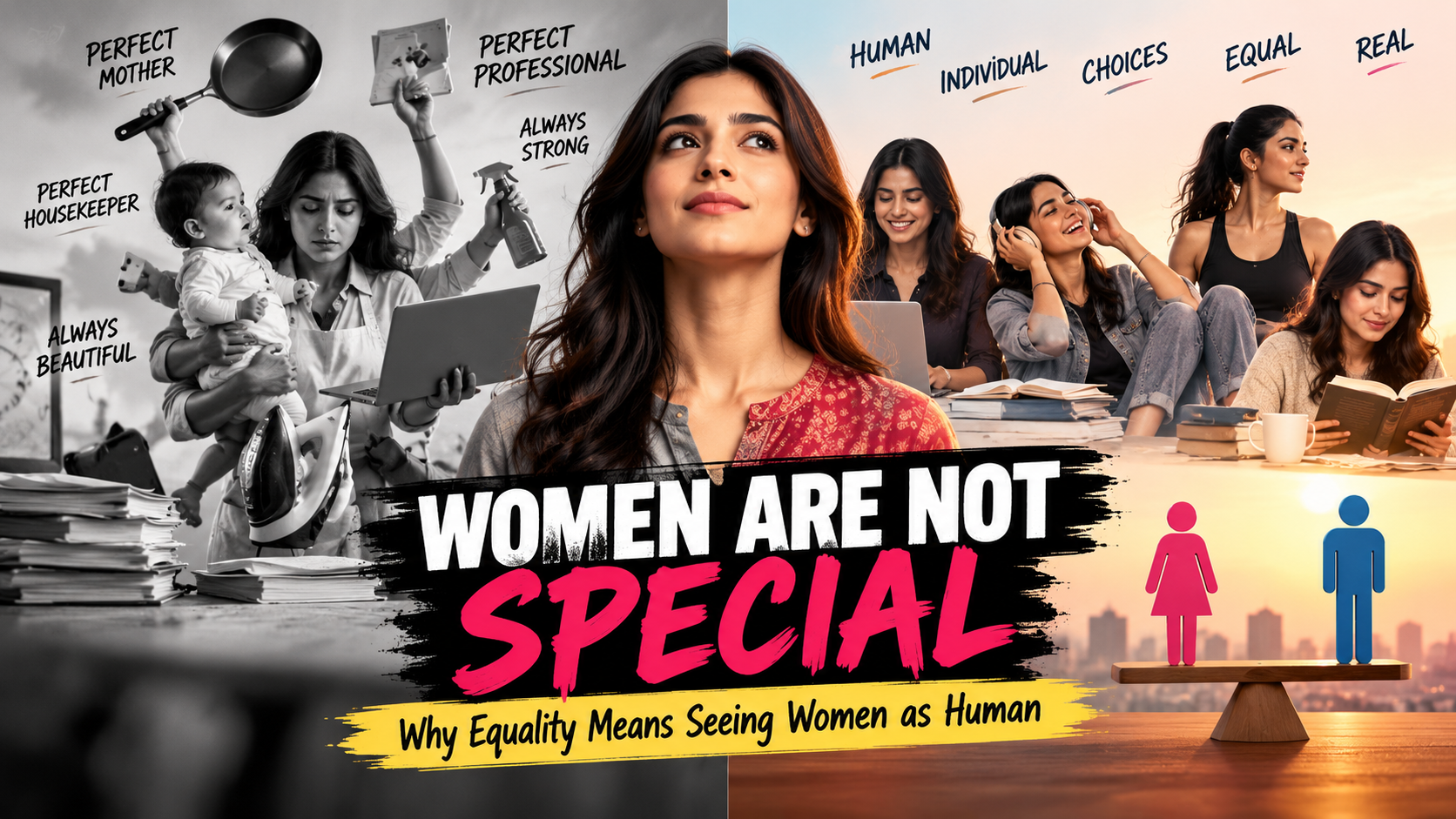
Women Are Not Special: Why Equality Means Seeing Women as Human
Sexism continues to exist across different sections of society, influencing how people are treated, the opportunities they receive, and the expectations placed upon them. As we examine the inequalities women experience, the meaning of equality becomes increasingly complex. Feminism, therefore, cannot be reduced to a single idea or approach. People interpret and practise it in different ways, depending on their experiences, beliefs, and understanding of society.
One approach to improving the treatment of women is to celebrate them as extraordinary beings who deserve admiration and respect. Although this may come from good intentions, placing women on a pedestal can create a different kind of inequality. It can replace negative stereotypes with positive ones without challenging the underlying belief that women must conform to a particular ideal.
We cannot overcome sexism by pretending that women are perfect. Women, like men, are human beings. They have strengths and weaknesses, make good and bad decisions, experience success and failure, and possess individual personalities that cannot be reduced to their gender.
The Problem With Idealising Women
Society often praises women for qualities such as kindness, patience, beauty, selflessness, and emotional strength. These qualities can certainly be admirable, but problems arise when they become expectations rather than personal choices.
Consider the familiar image of the perfect mother who always puts her family first, the ideal homemaker who manages every household responsibility effortlessly, or the successful professional who balances a demanding career with family life without ever appearing exhausted.
Such portrayals may appear flattering, but they can place enormous pressure on women to meet unrealistic standards. A woman who feels overwhelmed by motherhood may be judged as inadequate. A woman who prioritises her career may be criticised for neglecting her family. Someone who does not enjoy traditional domestic responsibilities may be treated as though she has failed to fulfil an essential part of her identity.
The problem is not that motherhood, caregiving, ambition, or kindness deserve less appreciation. The problem is assuming that every woman must embody these qualities in a particular way to earn respect.
When admiration depends on meeting an ideal, women are not necessarily being accepted for who they are. They are being rewarded for how closely they conform to society’s expectations.
How Media Reinforces Unrealistic Expectations
Advertising, films, television programmes, and social media can influence how people understand gender roles. Although media representation has become more diverse in many areas, familiar stereotypes continue to appear in different forms.
Women are frequently portrayed as naturally responsible for maintaining family relationships, managing domestic responsibilities, and preserving harmony at home. In some advertisements, women are shown completing household tasks effortlessly, while their appearance remains immaculate. When professional success is added to the picture, they may also be expected to look confident, attractive, and perfectly composed at all times.
These portrayals can make ordinary human experiences seem like personal failures. Being tired, struggling with work, making mistakes, or having an untidy home are normal parts of life. Yet, when media repeatedly presents idealised versions of womanhood, everyday imperfections can appear unacceptable.
Beauty advertising offers another example. Women are often encouraged to remove unwanted body hair, maintain youthful skin, and achieve narrow standards of physical attractiveness. There is nothing inherently wrong with enjoying beauty products or choosing to groom oneself. The concern is whether women are given genuine freedom to make those choices without being judged for looking different.
Better representation would show women with a wider range of appearances, personalities, ambitions, habits, and life experiences. It would allow them to be attractive or unattractive by conventional standards, organised or disorganised, serious or playful, without suggesting that any single characteristic defines all women.
Why Women Should Be Allowed to Be Imperfect
Positive stereotypes are still stereotypes. Describing women as naturally more caring, morally superior, emotionally intelligent, or self-sacrificing may sound complimentary, but it places people inside predetermined roles.
Women can be compassionate, but they can also be impatient. They can be confident, but they can also experience insecurity. They can be responsible, but they can also make irresponsible decisions. None of these qualities belongs exclusively to one gender.
The same principle applies to accountability. A woman’s actions should not automatically be excused simply because she is a woman, just as a man’s mistakes should not be treated as proof that all men behave badly.
Equality requires us to recognise individual responsibility without ignoring structural inequalities. Women should have the same opportunities to succeed, the same freedom to make personal choices, and the same dignity when they make mistakes.
Allowing women to be imperfect does not diminish their worth. It acknowledges that their worth does not depend on perfection in the first place.
Humour, Gender Roles, and the Freedom to Be Ordinary
Comedy provides another interesting example of how gender expectations influence representation. Traditional portrayals have often placed men in roles that allow them to be foolish, immature, clumsy, selfish, or socially awkward without making these qualities central to the way society understands all men.
Female characters, by contrast, have sometimes been written as the sensible voice of reason, the attractive romantic interest, the responsible parent, or the person expected to correct everyone else’s behaviour. Although these patterns are not universal, they can limit the range of personalities women are allowed to express on screen.
Women should be able to play ridiculous characters, make embarrassing mistakes, display eccentric behaviour, and participate in slapstick comedy without their actions being treated as representative of their entire gender.
At the same time, humour should not be judged solely by whether women are included in it. The important question is whether female characters are given the same freedom, complexity, and comic possibilities as male characters.
Representation becomes more meaningful when women are allowed to be complete characters rather than idealised symbols of femininity.
Equality Is Not the Same as Ignoring Inequality
Arguing that women are human beings rather than perfect ideals does not mean overlooking the discrimination they face. Women may encounter unequal opportunities, gender-based violence, workplace discrimination, unfair caregiving expectations, and restrictions on their personal autonomy.
These problems cannot be solved simply by changing the way women are portrayed in advertisements or films. They also require meaningful changes in institutions, workplaces, laws, social attitudes, and everyday behaviour.
Recognising women’s humanity is one part of a broader commitment to equality. It means respecting their autonomy, listening to their experiences, challenging unfair treatment, and avoiding assumptions about what they should want or how they should behave.
It also means understanding that equality does not require us to pretend everyone faces identical circumstances. Where discrimination creates unequal barriers, addressing those barriers may require specific measures and support.
The objective is not to declare women superior to men or to erase the differences between individuals. It is to ensure that gender does not determine a person’s worth, freedom, or access to opportunity.
From Putting Women on a Pedestal to Treating Them as Equals
Admiration can be valuable, and celebrating women’s achievements is important. The problem begins when admiration turns into an expectation that women must always be exceptional, selfless, beautiful, strong, or morally exemplary.
Women should not have to be extraordinary to deserve respect. They should not have to sacrifice their personal ambitions to prove that they are caring, nor should they have to demonstrate exceptional resilience to justify their place in society.
A woman who chooses motherhood deserves respect, but so does a woman who chooses not to have children. A woman who pursues a demanding career deserves recognition, but so does one who chooses a different path. Personal decisions should be evaluated on their own merits rather than measured against a universal definition of what a woman ought to be.
When society stops expecting women to represent an ideal, it becomes easier to recognise their individuality. They can be appreciated for their achievements without being placed beyond criticism, and they can be held accountable without being reduced to gender stereotypes.
Conclusion: Women Do Not Need to Be Perfect to Be Equal
Putting women on a pedestal may appear to be a gesture of respect, but genuine equality requires something more fundamental: recognising women as people rather than ideals.
Women are not universally selfless, naturally perfect, or morally superior. They are individuals with different personalities, aspirations, abilities, limitations, and experiences. The same is true of men.
We should challenge sexism wherever it appears, acknowledge the inequalities women face, and create a society in which everyone has the freedom to make choices without being confined by gender expectations.
The goal is not to replace the stereotype of the inferior woman with the stereotype of the flawless woman. It is to move beyond the need for stereotypes altogether.
Women do not need to be placed above men to be treated equally. They do not need to be idealised to deserve dignity, and they do not need to be perfect to be worthy of respect.
Perhaps the most meaningful form of equality begins when we stop asking women to be exceptional simply because they are women and start allowing them to be human.