Make Love, Not War: The Legacy of the 1960s Hippie Movement
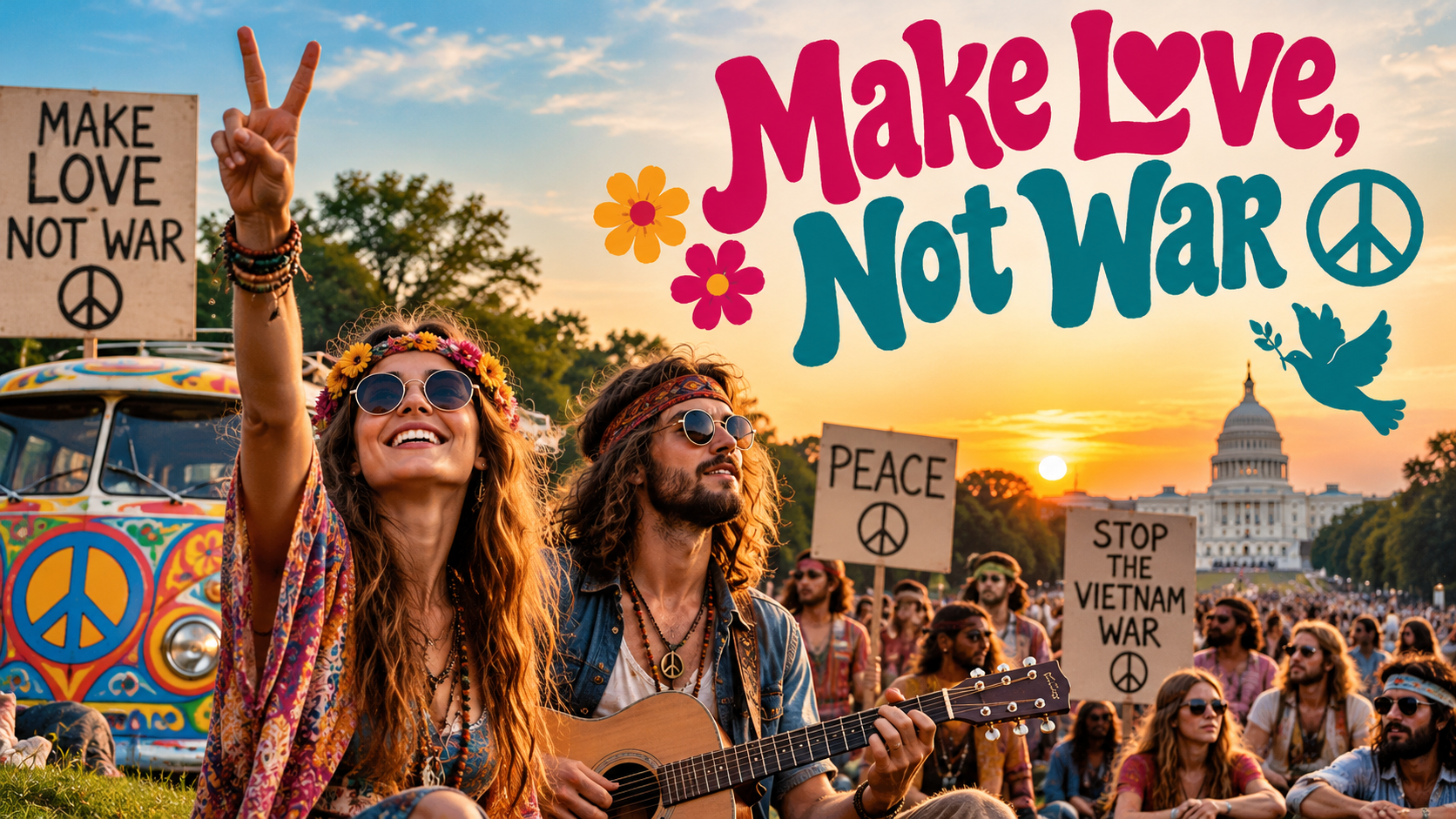
Long hair, colourful clothing, psychedelic music, and flowers tucked into headbands are among the images most commonly associated with hippies. Yet beneath this distinctive appearance lay a much larger cultural shift. The hippie movement of the 1960s represented a challenge to conventional ideas about authority, material success, personal freedom, and the way society should be organised.
For many young Americans, the promise of the American Dream seemed inseparable from expectations about wealth, conformity, race, gender, and family life. Those who questioned these expectations often found themselves at odds with mainstream society. Against this backdrop, a growing counterculture began searching for alternative ways to live, think, create, and relate to one another.
The result was a movement that became associated with peace, artistic experimentation, communal living, and resistance to established social norms. Although the hippie movement was diverse and sometimes contradictory, its influence extended far beyond fashion and music.
More Than Long Hair and Psychedelic Music
The word “hippie” often evokes images of bell-bottom trousers, flower crowns, rock concerts, and psychedelic art. These symbols certainly formed part of the movement, but they do not tell its whole story.
Emerging from earlier countercultural traditions, including the Beat Generation, the hippie movement gained visibility during the 1960s. Many of its followers questioned consumerism, rigid social expectations, and the assumption that a successful life had to follow a conventional path.
Some explored communal living, alternative spiritual traditions, and more environmentally conscious lifestyles. Others became involved in protests against war and injustice. Music, poetry, art, and public gatherings offered ways to express ideas that challenged the dominant culture.
It is important, however, not to treat all hippies as politically active or to imagine that they shared one consistent philosophy. The movement included people with different beliefs, priorities, and approaches to social change. Its significance lay partly in this diversity and in its willingness to question established assumptions.
The Vietnam War and the Call for Peace
One of the defining political issues of the era was the United States’ involvement in the Vietnam War. As American military involvement escalated, opposition grew among students, activists, religious groups, artists, and ordinary citizens. The military draft, mounting casualties, and increasingly visible images of the conflict intensified public debate.
For many young Americans, the war raised fundamental questions about government authority, democratic accountability, and the human cost of political decisions. College campuses became important centres of protest, while marches and demonstrations brought anti-war messages into public life.
The hippie counterculture became closely associated with this wider opposition to the war, although it was not identical to the anti-war movement. Some hippies participated directly in political demonstrations, while others expressed their opposition through art, music, alternative lifestyles, and a rejection of militarism.
The slogan “Make Love, Not War” captured the contrast between violence and compassion. It expressed a desire for a society in which human connection, peaceful coexistence, and personal freedom mattered more than military conflict.
Its appeal was not limited to a particular protest or political organisation. The slogan became a lasting cultural expression of the hope that disagreements could be addressed without turning to violence.
Flower Power: Turning Protest into a Symbol of Peace
Few images represent the 1960s counterculture more vividly than a flower held against the backdrop of a military weapon. This contrast became central to the idea of “Flower Power,” a phrase popularised by poet and activist Allen Ginsberg during the anti-war movement.
Rather than relying solely on confrontation, Flower Power encouraged demonstrators to use flowers, music, peaceful gestures, and symbolic acts to communicate opposition to war. Its message was simple: resistance could be expressed through creativity and compassion as well as through political argument.
The approach became associated with some of the era’s most memorable protest imagery, including demonstrations against the Vietnam War. Flowers came to represent an alternative to violence, suggesting that peace was not merely the absence of conflict but a conscious choice about how people should treat one another.
Flower Power did not end the war by itself, and peaceful protest was only one part of a much broader political struggle. Nevertheless, its imagery helped make the ideals of non-violence and human solidarity visible to audiences around the world.
Questioning Traditional Ideas About Society
The counterculture also challenged established expectations about gender roles, relationships, sexuality, and family life. Many young people rejected the belief that everyone should follow the same path towards marriage, employment, domestic responsibility, and social respectability.
These debates overlapped with wider movements for women’s rights, sexual freedom, and gay liberation. Activists questioned discrimination and demanded greater autonomy over their lives. However, these movements had their own histories, leaders, and political goals; they were not simply products of hippie culture.
The relationship between the counterculture and feminism was also complicated. Although some countercultural communities promoted sexual freedom and questioned conventional family structures, women within these spaces could still encounter unequal expectations and discrimination.
Recognising these contradictions makes the history more meaningful. A movement can challenge certain social restrictions while continuing to reproduce others. The important question is whether its ideals encourage people to identify those contradictions and work towards something better.
Environmental Awareness and Alternative Ways of Living
The hippie movement was also associated with communal living, a rejection of excessive consumerism, and an interest in living closer to nature. Some people left urban centres to establish rural communities, experiment with shared resources, or adopt simpler lifestyles.
These experiments reflected a wider dissatisfaction with the idea that material wealth should be the primary measure of success. For some, a fulfilling life meant stronger communities, creative expression, greater personal freedom, and a closer relationship with the natural world.
The environmental movement had its own scientific, political, and conservation traditions, but the counterculture helped bring ecological concerns into a broader conversation about how people lived and consumed. Interest in pollution, resource use, and environmental responsibility became part of the period’s wider questioning of modern society.
Not every communal experiment succeeded, and idealistic intentions did not always translate into sustainable practices. Still, the willingness to explore alternatives helped make everyday habits and consumer choices subjects of cultural debate.
Music, Art, and the Power of Cultural Expression
Music played a central role in the counterculture. Folk, rock, and psychedelic music provided a shared language through which young people could express frustration, hope, identity, and opposition to war. Concerts and festivals brought large audiences together around artistic experimentation and a sense of collective experience.
The 1967 Summer of Love in San Francisco and the 1969 Woodstock festival became enduring symbols of this cultural moment. They represented the appeal of community, music, and freedom to a generation seeking alternatives to conventional life.
Artists, writers, and musicians also helped circulate countercultural ideas beyond the communities in which they first emerged. Posters, poetry, performances, and protest songs gave abstract political questions an emotional and visual form.
Art did not always provide answers, nor did everyone interpret it in the same way. Its power often came from opening conversations, challenging familiar images, and making people feel that another way of seeing the world was possible.
Was the Hippie Movement Really a Revolution?
The hippie movement is sometimes remembered as a romantic era of freedom, peace, and youthful rebellion. Such memories can overlook its limitations, internal conflicts, and the practical difficulties of sustaining alternative communities.
Drug use, for example, became associated with parts of the counterculture, but it also carried serious risks. Not every experiment in personal freedom produced positive outcomes, and not every community lived up to its ideals of equality and mutual respect.
It would also be inaccurate to credit hippies alone with the major social changes of the period. Civil rights campaigners, feminist organisers, environmental advocates, labour activists, and LGBTQ+ rights campaigners pursued their own struggles, often over many years and sometimes in opposition to one another.
Nevertheless, the counterculture helped bring certain ideas into wider public view. It encouraged people to question unquestioned authority, reconsider materialistic definitions of success, and imagine alternatives to established social conventions.
Its influence can be understood less as a single revolution that transformed society overnight and more as one part of a broader period of cultural and political change.
Why “Make Love, Not War” Still Matters
The world has changed considerably since the 1960s, but the questions behind the slogan remain relevant. How should governments be held accountable for decisions involving war? How can societies protect individual freedom while respecting the rights of others? What does a meaningful life look like beyond wealth and status? And how can people with different beliefs coexist without resorting to hatred or violence?
There are no simple answers to these questions. Peace requires more than a memorable slogan, just as social progress requires more than rejecting tradition. It calls for dialogue, accountability, equal rights, and a willingness to confront injustice even when doing so is uncomfortable.
The enduring value of “Make Love, Not War” lies in the principle it represents: compassion should not be mistaken for weakness, and questioning authority should not automatically be dismissed as rebellion without purpose.
The hippie movement was imperfect, diverse, and often contradictory. Yet its legacy reminds us that cultural change frequently begins when people refuse to accept that the existing order is the only possible way to live.
Ultimately, making love rather than war is not simply a slogan about romance or nostalgia for the 1960s. It is an invitation to consider what a more peaceful, thoughtful, and humane society might look like—and what each generation can do to help build it.