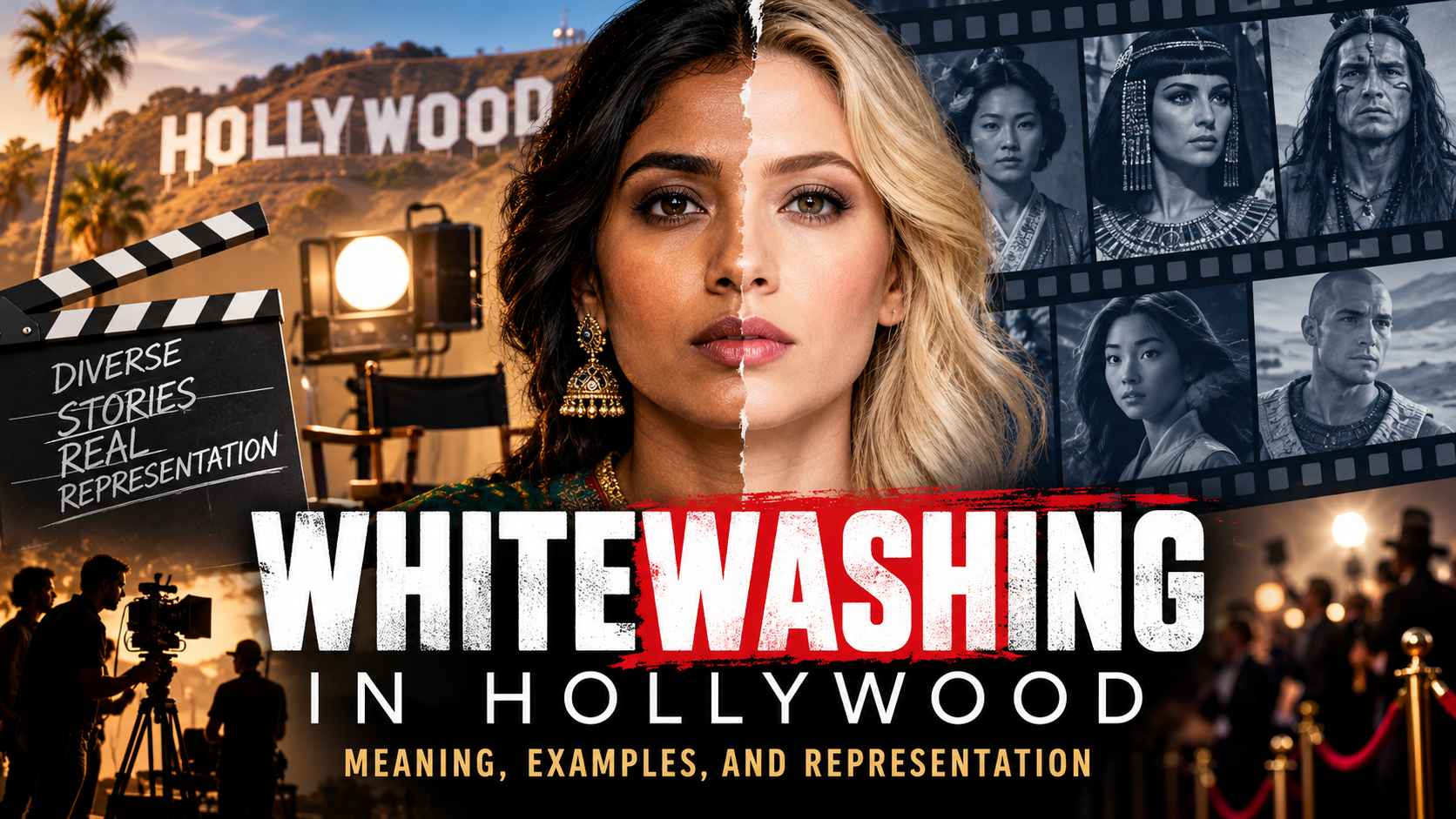
Whitewashing in Hollywood: Meaning, Examples, and Representation
Hollywood has the power to shape how millions of people see the world. But when the film industry repeatedly overlooks minority actors or changes the cultural identities of characters, an important question emerges: whose stories are being told, and who gets the opportunity to tell them?
For decades, Hollywood has faced criticism over the representation of racial and ethnic minorities in mainstream cinema. Although the industry has produced countless memorable films, its history also includes casting decisions that have sparked debates about race, identity, and cultural authenticity. One of the most widely discussed issues is whitewashing in Hollywood.
Whitewashing is more than a disagreement over casting. It raises questions about equal opportunities, the portrayal of different communities, and the influence that popular entertainment has on society. While the film industry has made progress in some areas, these discussions remain relevant whenever a character’s identity is overlooked or a community’s story is told without meaningful consideration of its cultural background.
What Is Whitewashing in Hollywood?
Whitewashing generally refers to the practice of casting white actors in roles associated with people of colour or altering stories in ways that erase, minimize, or misrepresent the identities of minority characters and communities.
The term is often used when a film adaptation changes a character’s racial or ethnic background, particularly when the original character belongs to a historically underrepresented group. It can also describe broader patterns in which minority characters are excluded from prominent roles while white characters dominate mainstream storytelling.
However, not every casting decision involving an actor and a character from different backgrounds is automatically whitewashing. Historical context, the nature of the role, the source material, and the opportunities available to underrepresented performers all matter. The central concern is whether casting and creative decisions contribute to the erasure or misrepresentation of communities that have traditionally received limited opportunities in cinema.
Why Representation in Movies Matters
Films do more than entertain. They introduce audiences to different cultures, shape perceptions of social groups, and influence conversations about identity and belonging. Characters on screen can become role models, challenge existing assumptions, or reinforce stereotypes that have persisted for generations.
When certain communities are consistently absent from leading roles, audiences may receive a narrow picture of society. When those communities are represented only through stereotypes, the consequences can be equally damaging. Authentic and thoughtful representation, on the other hand, can help viewers appreciate experiences different from their own.
Representation is particularly meaningful for younger audiences. Seeing people from their backgrounds portrayed as heroes, professionals, leaders, and complex individuals can help them recognize that their stories deserve attention too.
This does not mean that every character must be played by an actor with an identical personal background. Rather, it means that filmmakers should consider cultural context, provide fair opportunities, and avoid treating identity as an insignificant detail when it is central to a character or story.
Famous Examples of Whitewashing in Hollywood
Several Hollywood productions have become prominent examples in discussions about whitewashing. These films illustrate how casting choices can raise questions about historical accuracy, cultural identity, and opportunities for actors from underrepresented communities.
1. Elizabeth Taylor as Cleopatra
Elizabeth Taylor portrayed Cleopatra in the 1963 film Cleopatra. Cleopatra VII ruled ancient Egypt as a member of the Ptolemaic dynasty, a ruling family of Greek Macedonian origin. The details of Cleopatra’s maternal ancestry remain uncertain, and her identity continues to attract historical discussion.
Taylor’s casting is often mentioned in conversations about Hollywood’s portrayal of historical figures from the ancient Mediterranean and North Africa. The broader debate highlights the challenges filmmakers face when depicting historical figures whose cultural identities and backgrounds are complex or contested.
2. Laurence Olivier as Othello
In the 1965 film adaptation of William Shakespeare’s Othello, Laurence Olivier, a white British actor, played the Moorish protagonist using dark makeup. The performance has since drawn criticism because of its association with blackface and the history of racial caricature in theatre and film.
The controversy illustrates how artistic traditions can change in meaning over time. It also raises questions about whether established theatrical practices should be reconsidered when they perpetuate harmful racial imagery or limit opportunities for actors of colour.
3. Ben Affleck as Tony Mendez in Argo
Ben Affleck portrayed CIA officer Tony Mendez in the 2012 film Argo, which dramatizes a covert operation during the Iran hostage crisis. Mendez was of Mexican-American heritage, and Affleck’s casting prompted criticism and discussion about the representation of Latino people in Hollywood.
The debate focused on a wider issue: whether actors from historically underrepresented backgrounds receive fair opportunities to portray characters whose identities reflect their own communities. Such discussions are not limited to one film; they form part of a continuing conversation about access, visibility, and inclusion in the entertainment industry.
4. Johnny Depp as Tonto in The Lone Ranger
Johnny Depp played Tonto, a Native American character, in the 2013 film The Lone Ranger. His casting generated criticism and renewed discussion about the portrayal of Indigenous peoples in mainstream entertainment.
For many critics, the issue extended beyond the casting of one actor. It involved the long history of Indigenous characters being portrayed through stereotypes and the limited opportunities Native American performers have historically received in major productions. The discussion also highlighted the importance of cultural consultation and respectful storytelling.
How Whitewashing Affects Minority Communities
The effects of whitewashing can extend beyond an individual movie. Casting decisions influence who receives professional opportunities, whose performances gain recognition, and which communities become visible in popular culture.
When actors from minority backgrounds are repeatedly overlooked for roles connected to their communities, the industry risks reinforcing existing barriers. Talented performers may lose opportunities to build their careers, while audiences miss the chance to experience a wider range of perspectives.
Whitewashing can also affect cultural understanding. When a story is adapted without sufficient attention to its historical or cultural context, important details may be simplified or lost. Characters can become disconnected from the communities and experiences that originally gave them meaning.
At the same time, meaningful representation involves more than the identity of an actor. Writers, directors, producers, costume designers, and cultural advisers can all contribute to a more thoughtful portrayal. Diverse creative teams can help ensure that stories are developed with greater depth and that cultural details are not treated as superficial decoration.
Is Hollywood Becoming More Inclusive?
Conversations about diversity and representation have become an important part of the film industry’s public discussion. Filmmakers and audiences increasingly scrutinize casting choices, cultural portrayals, and the opportunities available to performers from underrepresented backgrounds.
Films that explore culturally specific experiences can broaden audiences’ understanding of the world and demonstrate that stories from different communities can connect with viewers across national and cultural boundaries.
Nevertheless, greater awareness does not mean every problem has been resolved. Representation must be considered throughout the filmmaking process, from the initial script to casting, production, promotion, and creative leadership. Progress requires more than occasional high-profile films; it requires sustained opportunities for diverse talent across the industry.
How Can Hollywood Reduce Whitewashing?
Creating a more inclusive film industry requires thoughtful decisions and practical changes. Several approaches can help improve representation without restricting creative freedom.
- Encourage fair casting: Ensure that qualified performers from underrepresented communities have meaningful opportunities to audition for appropriate roles.
- Respect cultural and historical context: Consider whether changes to a character’s background affect the meaning or authenticity of the original story.
- Support diverse creative teams: Create opportunities for writers, directors, producers, and other professionals with different experiences and perspectives.
- Challenge harmful stereotypes: Develop multidimensional characters instead of relying on simplistic or outdated portrayals of racial and cultural groups.
- Consult relevant communities: When a story draws heavily on a particular culture or history, seek informed perspectives to improve its accuracy and sensitivity.
- Expand opportunities behind the camera: A more inclusive industry should provide pathways to leadership and decision-making, not only visibility on screen.
Whitewashing and Creative Freedom: Finding the Balance
Discussions about whitewashing can become complicated because casting also involves artistic interpretation, performance, and the practical requirements of a production. Actors frequently portray people whose lives and experiences differ from their own, and this is a normal part of acting.
The question is not whether actors should be limited to playing versions of themselves. Instead, it is whether casting decisions are fair, whether culturally significant identities are respected, and whether the industry provides comparable opportunities to talented performers from different backgrounds.
Historical dramas, fantasy films, adaptations, and fictional stories may each require different considerations. A thoughtful approach recognizes these differences while still taking seriously the effects of exclusion and misrepresentation.
Conclusion: Every Community Deserves to Be Seen
Whitewashing in Hollywood reflects a broader conversation about representation, opportunity, and the power of storytelling. Films can influence how people understand communities beyond their own, making the choices of filmmakers significant both culturally and socially.
Building a more inclusive film industry does not require every casting decision to follow a single formula. It requires filmmakers to consider context, challenge longstanding inequalities, and give talented people from diverse backgrounds fair opportunities to contribute.
When stories are told with care and characters are portrayed with depth, cinema becomes richer and more meaningful. Audiences gain access to a wider range of experiences, while communities that have historically been overlooked have more opportunities to participate in shaping the stories the world sees.
Ultimately, representation is not simply about who appears on screen. It is about recognizing the value of different experiences and ensuring that the stories of our diverse world have a fair chance to be heard.
Frequently Asked Questions
What does whitewashing mean in movies?
Whitewashing in movies generally refers to casting white actors in roles associated with people of colour or changing a story in ways that erase or diminish the cultural identity of minority characters.
What are some examples of whitewashing in Hollywood?
Frequently discussed examples include Elizabeth Taylor as Cleopatra in Cleopatra (1963), Laurence Olivier as Othello in Othello (1965), Ben Affleck as Tony Mendez in Argo (2012), and Johnny Depp as Tonto in The Lone Ranger (2013).
Why is whitewashing considered a problem?
Critics argue that whitewashing can reduce opportunities for minority actors, reinforce stereotypes, and weaken the cultural authenticity of stories. It can also affect which communities are visible in mainstream entertainment.
Is whitewashing the same as cultural appropriation?
No. Whitewashing generally concerns the erasure or replacement of minority identities in casting or storytelling. Cultural appropriation refers to the adoption or use of elements from another culture, particularly when issues of power, respect, and exploitation are involved. The two concepts can overlap, but they are not identical.
How can filmmakers improve representation?
Filmmakers can improve representation through fair casting, culturally informed storytelling, diverse creative teams, consultation with relevant communities, and greater access to opportunities for underrepresented performers and professionals.
At its best, cinema helps us understand lives beyond our own. That opportunity should extend to the people who create its stories as well as those who watch them.